
As I mentioned in an earlier post, I’ve been wearing a heart monitor since 6-November, and will continue to do so until 6-December. I’ve not heard anything new from the cardiologist since that call telling me it had recorded an instance of atrial fibrillation.
What I haven’t written about yet, is the problems I had wearing that monitor for the first couple of weeks. I have very sensitive skin, and a severe allergy to latex. I get rashes severe enough to qualify as chemical burns upon prolonged (6+ hours) exposure. This came about as a result of wearing latex gloves for several months while tending Barbara’s wound, and her colostomy bag.
From about hour 12 of wearing the monitor using a single attachment point (called a strip), I began noticing it was irritating my skin. I thought I could deal with it, and tried to ignore it. I honestly don’t know for certain if there’s latex in that strip used to attach the monitor to the chest. All I know for certain is that I when I removed that first strip after seven days, my skin between my breasts was showing that type of irritation, though mild at that point. I still thought I could handle it, and attached a second strip for the next week.
Ultimately, on about day 4 of the second week (Thursday), I broke down and called patient support and asked for help. A very kind representative listened to me complain about the irritation, which by that point was constant and severe. I was also out of new strips, because I had damaged a couple of them trying to relieve the pain I was experiencing. So I was mainly calling to get new strips sent to me for the next change, due on the upcoming Monday evening.
At that point, my allergy to latex hadn’t occurred to me as possibly related, so I didn’t ask if there was any latex in the adhesive used in that attachment strip. I doubt that the representative would have had that level of product knowledge in any case.
She suggested I should consider an alternative method of attachment, which uses typical ECG pads and lead wires to the actual monitor. She placed an order for me for more strips, as well as the necessary supplies for the alternate method of use. They were to arrive on the next Monday morning. I really thought I would still use the “strip” attachment at that point.
By the time Monday morning rolled around though, there was no doubt in my mind that I would be changing to the alternate method with lead wires. By that time, the damage done to my skin was severe, and clearly getting worse. That was 20-November. The image below is what my skin looked like a couple of hours after removing that strip and changing to the alternate method.
Content warning for image of skin injury.
.
.
.
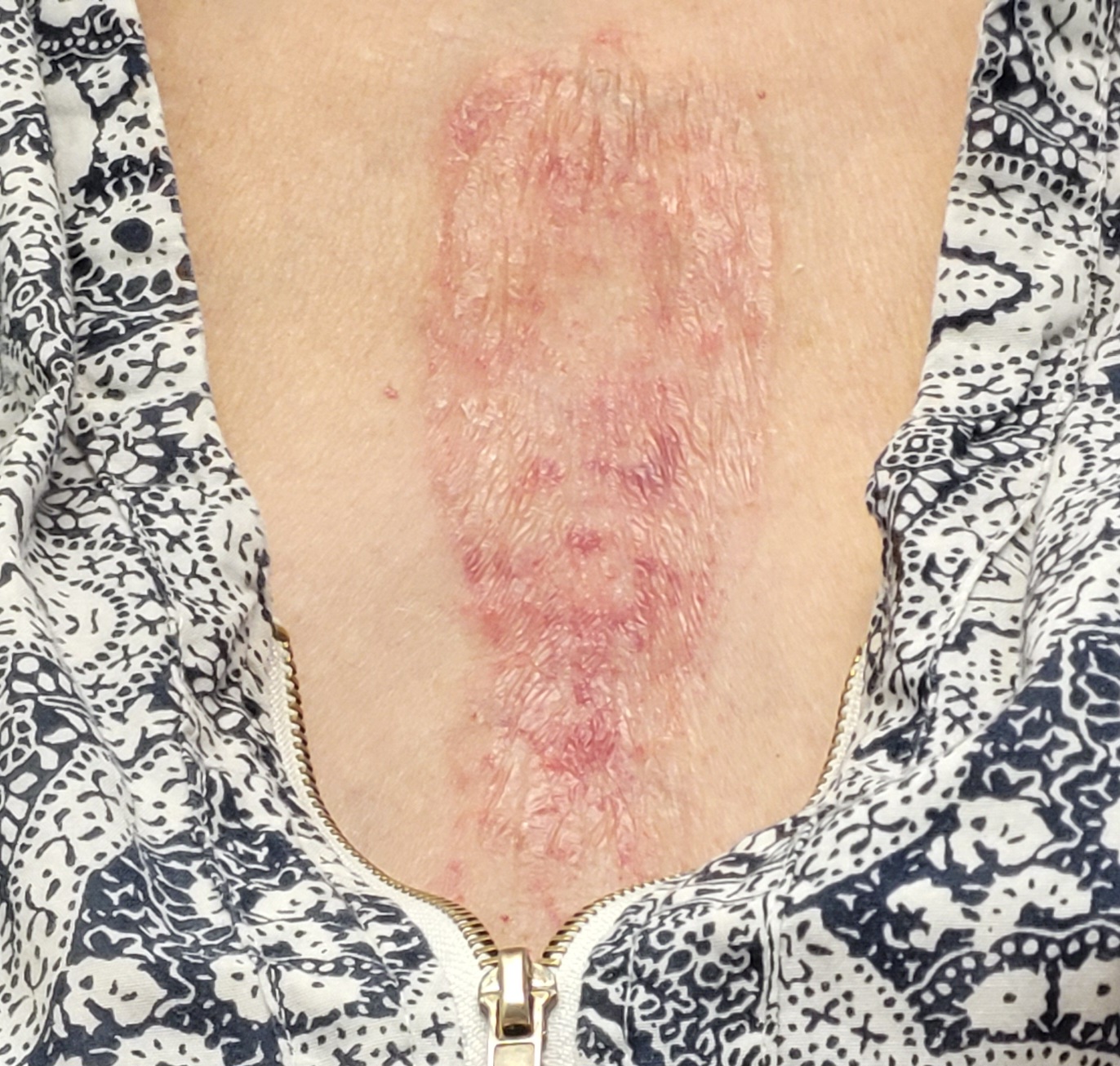
Thankfully, that alternate method has been much less harmful to my skin. In addition, I can move the attachment points slightly every three days when I replace the ECG pads, allowing healing of the prior point. Nine days later, it seems pretty clear to me that the area seen in the photo above will be permanently scarred. It’s no longer red like that, but the outline is still clearly visible. It’s more of a light brown color now, and is rough to the touch.
So, if you have sensitive skin like I do, and you ever have to wear a heart monitor for more than a couple of days, you might want to start out from the beginning using the leads rather than the, admittedly more convenient, strip attachment. Forewarned is forearmed, as the proverb goes.

 An Aging Trans Woman
Leave a comment